Use AI to build your practice · from a psychologist, not an agency

Stop guessing what to fix — or build — next.

It starts with your website. Most therapist sites share the same handful of problems — the right clients are finding you, they just can't tell, fast enough, that you're for them. See exactly what's costing you clients — then learn to fix it yourself, with AI, the safe way.

Dr. Nicholas Gehle, Psy.D. · licensed clinical psychologist, building Strua in public
Free: your Recognition Score + "The Therapist's First Hour With AI." No charge.
Free · no email needed · nothing stored

The people who need you can't tell you're for them.

Get your free Recognition Score — a psychologist's diagnostic, not a website audit. Paste your homepage and see what a first-time visitor (and an AI) can and can't tell about your practice in seconds, plus the one thing to fix tonight. No AI inside it — every finding traces to a transparent rule.

Your Recognition Score
Free, instant, and the score is yours either way — no email wall.
What one fix looks like

One rewrite — from invisible to “that's me.”

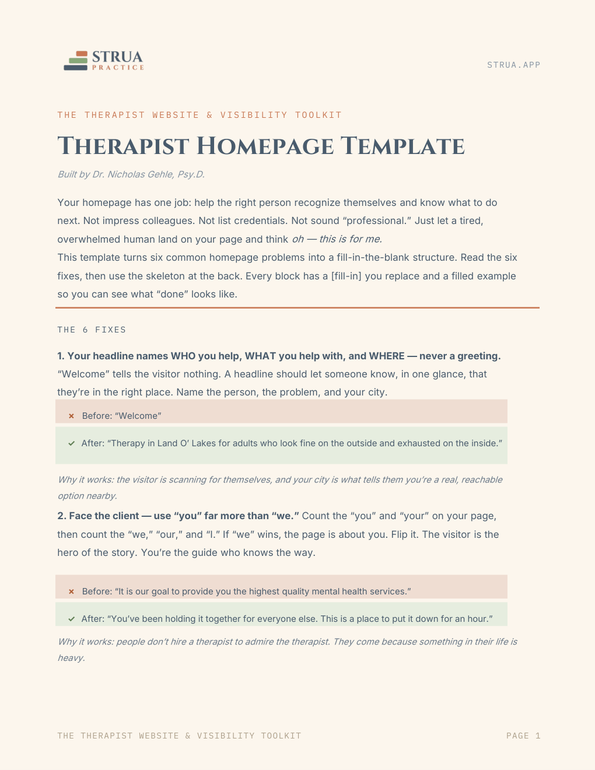
✗  Before
“Welcome. It is our goal to provide the highest quality mental health services.”
No city No niche No next step
↓  one rewrite  ↓
✓  After
Therapy for overwhelmed adults in Land O' Lakes — who look fine on the outside and exhausted on the inside.
Specific Human Findable
Book a free consultation
How it works

Three steps — the first two are free.

1Free

Diagnose

Your Recognition Score. See exactly why the right clients can't tell you're for them.

2Free

Learn the skill

The Therapist's First Hour With AI. Your first hour using AI to fix it — no tech skills, fully inside your ethics.

3$49

Fix it fully

Practice Builder: Get Found. The complete system — guided AI prompts that teach you to fix it yourself. Stage 1 of the Builder's Path.

The painful truth
Your homepage says:
“Welcome.”
Everyone else's does too.
Your Psychology Today profile starts with:
“I am a Licensed…”
So do the 40 profiles around yours.
You ask AI: “Find a therapist near me for anxiety.”
It never mentions you.
It can't recommend what it can't understand.
Most therapists assume they need more traffic.Most actually need more clarity.

The right client visited your website.

They left in 17 seconds.

Not because they disagreed with you.

Because they couldn't tell, fast enough, that you were for them.

AI can't recommend what it can't understand. Neither can a scared person at 11pm.

The patterns we see again and again

These aren't random mistakes. They're the same six, on almost every site.

01
The “Welcome” headlineGreets visitors instead of naming who you help.
02
“I help everyone”Couples, teens, trauma, grief, ADHD… so no one feels chosen.
03
Credential-first profileOpens with “I am a Licensed…” — like the 40 profiles around it.
04
The buried next stepFive ways to contact you, so visitors take none of them.
05
The jargon wall“Evidence-based modalities” — words no anxious person types.
06
No city, anywhereSo neither Google nor a local client can place you.

Each one is a symptom of the same root cause:
a highly-trained clinician communicating like a clinician — instead of like a human.

You were trained to hold nuance and avoid overgeneralizing. Great in the room. Quietly invisible online. No marketing agency can name that — because they've never sat in your chair.

Why I built this

A psychologist who builds — and kept seeing the same thing.

I'm a licensed clinical psychologist with an MBA, and I build real software — Strua, a mental-health app — in public.

Spend time around therapist websites and the same few problems show up on almost all of them: a “Welcome” headline, too much jargon, no clear niche, a weak next step. Brilliant clinicians, quietly invisible online.

It isn't really a marketing problem. It's that we were trained to communicate like clinicians — not like the person in pain who's deciding, in a few seconds, whether we're for them.

So I built this: not a done-for-you service, but a way to use AI — safely, inside our ethics — to fix it yourself. Start with the website. The same skill builds everything else.

— Dr. Nicholas Gehle, Psy.D.

The visibility stack

Clients move through five layers. Most therapists optimize one.

A client looking for help anxious · skimming · 11pm
Psychology Today the opening line
Google & Maps local search
AI search can it understand you?
Your website do they recognize themselves?
A consult request

Practice Builder: Get Found teaches you to use AI to fix every layer — yourself, without hiring an agency.

Step 2 · Learn the skill · free

The Therapist's First Hour With AI

Five guided experiments — your first real hour using AI to make your practice easier to find and recognize. No tech skills, no client data, fully inside your ethics.

5experiments
1hour
$0to start
Send me the First Hour
Just your email. No spam, never shared.
You'll also get the Builder's Letter — the weekly note on using AI to build the practice your training never taught you to build. Unsubscribe anytime.
Practice Builder: Get Found · $49 · Stage 1 of the Builder's Path

Your first real project: use AI to make your practice easy to find.

Not templates to fill in blindly — guided AI prompts and frameworks that teach you to fix your website, profile, and local visibility yourself, safely and inside your ethics. The first practical application of building your practice with AI.

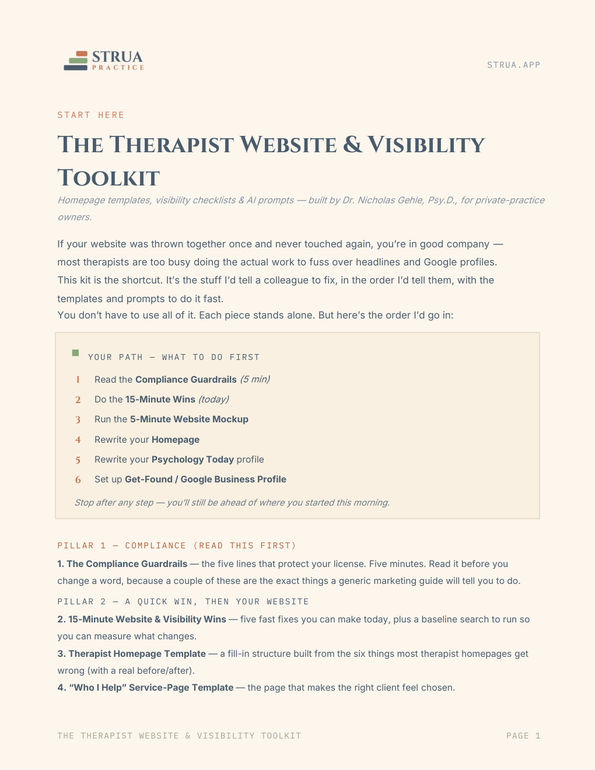
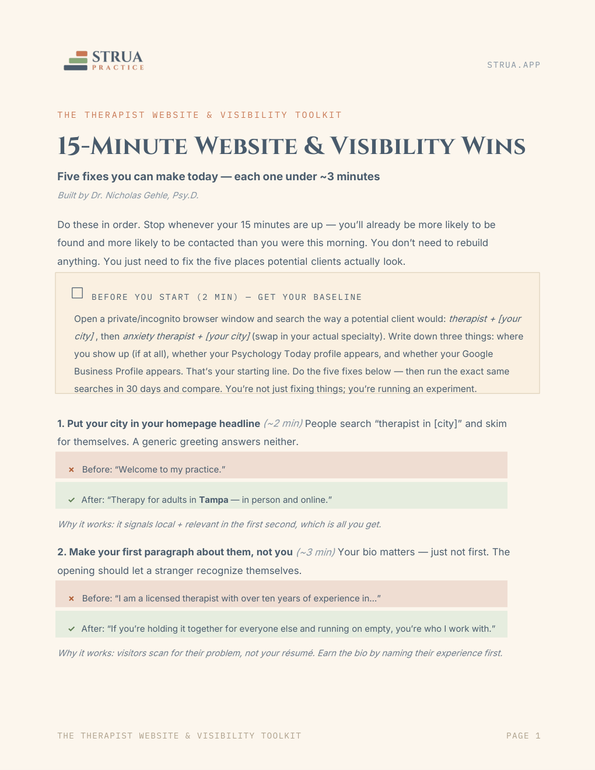
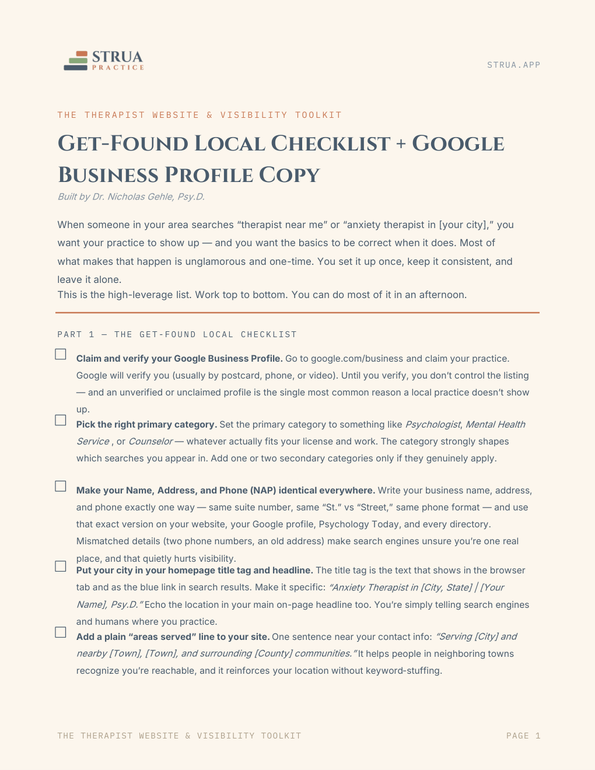
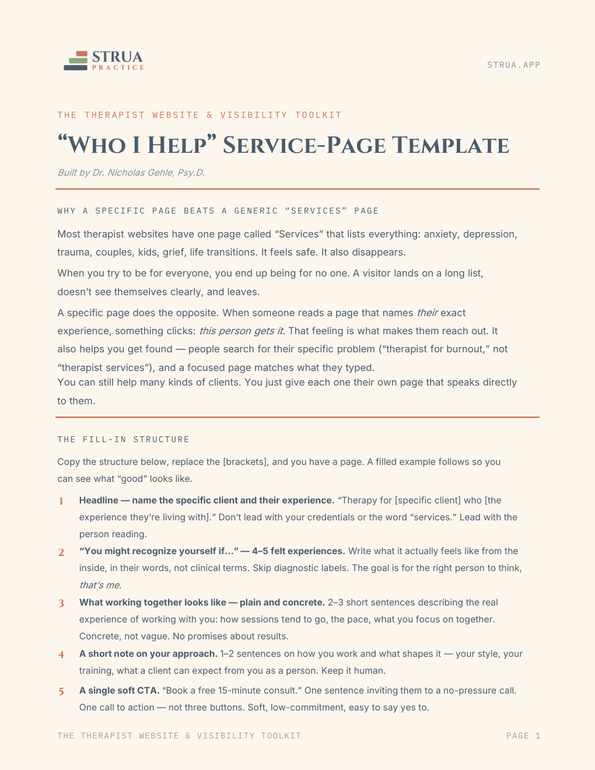
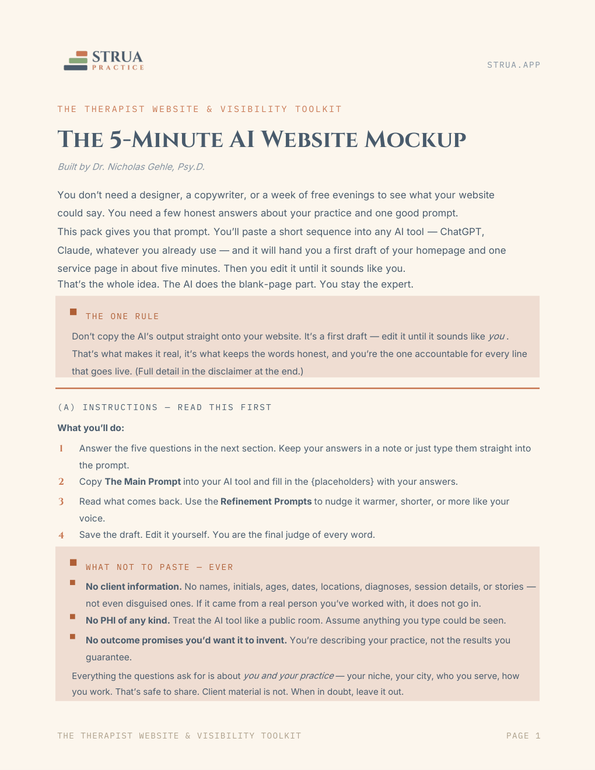
Start Here Compliance Guardrails Homepage Template Psychology Today Rewrite 15-Minute Wins Get-Found Checklist Service Page Template AI Website Mockup

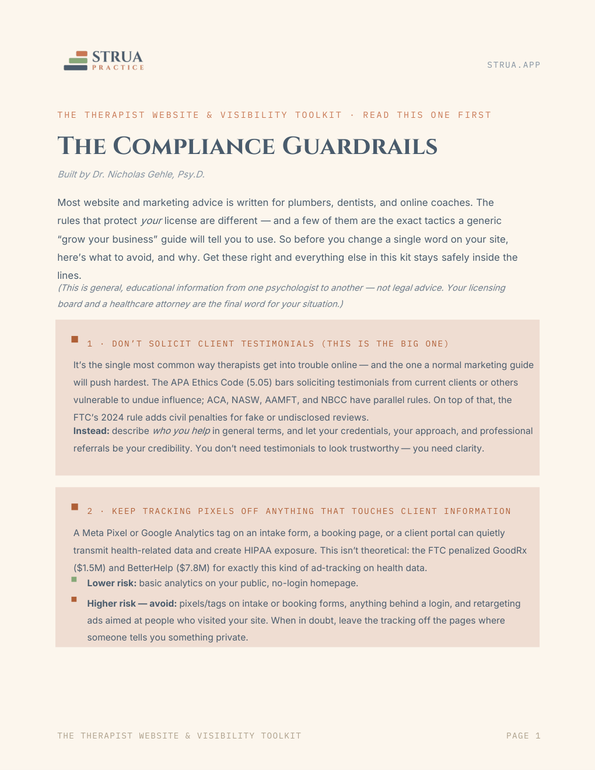
Compliance Guardrails

Don't accidentally create ethical or legal risk. The five marketing landmines — and how to stay inside your board's rules.

Homepage Template

Fix the six mistakes most therapist homepages make — a fill-in structure with a real before/after.

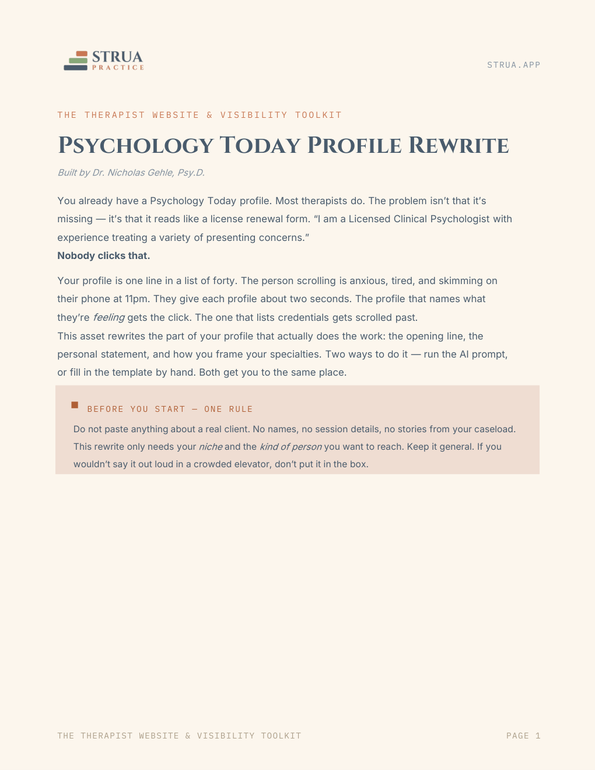
Psychology Today Rewrite

The one sentence that decides whether anyone clicks — and how to write yours.

5-Minute AI Website Mockup

Generate a complete homepage draft in minutes — with the ethics guardrails built into the prompt itself.

Get-Found Local Checklist

Google Business Profile, local visibility, and the AI signals that decide whether you show up nearby.

“Who I Help” Service Page

The page that makes the one right client feel chosen — instead of one more generic services list.

The $49 decision

Three ways to handle this.

Hire an agency
$2k–$10k+
Months of back-and-forth — and they may not understand therapist ethics.
Ignore it
$0
Nothing changes. The right clients keep scrolling past you.
Use Practice Builder
$49
Fix the highest-impact problems yourself — this weekend, with AI.
Get Practice Builder: Get Found
Why listen to me

Most people teaching this are marketers. I'm the psychologist who ships.

Licensed clinical psychologist (Psy.D.)
MBA
Built & ran a private practice
Built Strua, a real mental-health app
Uses AI daily to build
Teaches the ethics + compliance, not just tactics
Honest answers

The questions therapists ask first.

Is this just marketing fluff dressed up for therapists?

No. It's guided AI prompts and a clear order of operations, from a licensed psychologist who knows what you can and can't ethically do online. Compliance is the first piece in the kit, not an afterthought. If a tactic could put your license at risk, it's not in here.

I'm not techy. Will I actually be able to use it?

Yes. Most of the wins are editing words you already have — your homepage's first line, your Psychology Today opening sentence. No code, no rebuild, no designer. The AI pieces hand you a first draft; you edit it until it sounds like you.

What if someone else manages my website?

Even better. You don't have to touch a thing — the toolkit tells you exactly what's wrong and what to change, so you can hand a clear, prioritized list to your web person, assistant, or spouse. Most therapists have never been able to say precisely what they want fixed. Now you can.

I know it needs work but I have no idea where to start.

That's the most common place to be — and exactly what this is for. It's a clear order of operations: do the highest-impact thing first, stop whenever your time runs out, and you're still ahead of where you started. You're buying direction and confidence, not a pile of homework.

What about HIPAA and my ethics code?

That's the part most marketing advice gets dangerously wrong — testimonials, tracking pixels, outcome promises. The toolkit's opening section walks the five landmines and how to stay inside APA/ACA rules and FTC guidance. It's educational guidance, not legal advice — your board always wins — but it's built by someone who lives inside those rules.

Do I need to be good at AI?

No — that's the point. This teaches you to use AI from zero, with the exact prompts, safely and inside your ethics. AI does the heavy lifting on the blank page; you stay the expert on every word that goes live. Learning to use AI well IS the real skill you're building here — starting with your website.

Will this help my actual clients, or just my caseload?

Both. A clearer website helps the right person recognize themselves and reach out — which means the people who need your particular work are the ones who find you. Being easier to understand is a service to them, too.

This is really about one thing: becoming easier to understand.

It starts with your website — but the same skill carries into your Psychology Today profile, your Google listing, AI search, your handouts, your talks. Start where it's easiest. This weekend. For $49.

Get Practice Builder: Get Found